From Contemporary Dance to Pilates: A Movement Expert's Journey
“Why does a dance major do Pilates?”
This has been the most frequent question I’ve received over the past decade. And in answering it, I inevitably end up telling my entire story—from entering Chung-Ang University’s dance department at twenty, to now running mm Pilates and mm barre n yoga in Sangam-dong, Seoul, and serving as Vice President of WILA (Wellness Industry Leaders Association).
Today, I’d like to tell that story from the beginning.
Julia’s Movement Journey at a Glance
| Year | Milestone |
|---|---|
| University | B.A. in Contemporary Dance, Chung-Ang University |
| Master’s | Dance & Pilates correlation research |
| Doctoral | Sports Science (Motor Control) — Ph.D. coursework |
| 2021 | Founded mm Pilates in Sangam-dong, Seoul |
| 2023 | fonv National Director, KPGA conference presenter |
| 2024 | Opened mm barre n yoga (same building, 5F) |
| Present | WILA Vice President, international seminar instructor |
How Did You First Discover Movement at Chung-Ang University?
Contemporary dance’s freedom to explore movement without fixed frameworks sparked the questions about anatomy that eventually led me to Pilates.
I chose contemporary dance out of a simple desire to tell stories through the body. I appreciated ballet’s strict formal beauty and Korean dance’s deep breathing, but I was drawn to the freedom of contemporary dance—the ability to explore movement itself without a fixed framework. That was its greatest appeal for me.
During my university years, I began wrestling with the gap between “feeling” movement and “understanding” it. On stage, I relied on sensation and emotion, but back in the practice room, questions arose: “Why does this muscle respond this way in this movement?”
These questions led me to study anatomy and exercise physiology, which ultimately led me to Pilates.
What Is the Connection Between Contemporary Dance and Pilates?
My master’s research confirmed that dance and Pilates aren’t opposites — they coexist on a single spectrum, with Pilates addressing the vulnerabilities dancers face.
In graduate school, I formally researched the relationship between contemporary dance and Pilates. My thesis examined what effects Pilates training has on contemporary dancers.
Through the research, I made a fascinating discovery: dance was deeply involved in Joseph Pilates’ development of his method. In New York, he exchanged ideas with legendary choreographers like Martha Graham and George Balanchine, and many dancers trained at his studio.
What I Discovered in the Dancer’s Body
Dancers possess physical abilities far superior to the general population, but they also have very specific vulnerabilities: joint stress from repetitive jumping and landing, instability caused by extreme flexibility, and muscle imbalances from asymmetrical movement patterns.
Pilates proved highly effective at addressing these vulnerabilities. Compensating excessive flexibility with stability, developing imbalanced strength more evenly, and gently rehabilitating joints fatigued by repetitive impact. My master’s research confirmed these effects with data.
This experience became a crucial turning point for me. If dance was “artistic expression,” Pilates was “scientific movement.” And these two weren’t in opposition—they coexisted on a single spectrum.
How Does Motor Control Apply to Pilates Instruction?
Motor Control — the study of how the brain plans and executes movement — provides the scientific basis for personalized cueing and exercise modification.
After completing my master’s and working as a Pilates instructor, another question emerged: “How do people learn movement?” Even teaching the same Pilates exercise, some clients master it quickly while others take much longer. This wasn’t simply a matter of strength or flexibility. I could see that the way the brain processes movement itself was different.
To find answers, I entered a doctoral program in Sports Science, specializing in Motor Control.
Motor Control studies how humans plan, execute, and correct movement. It’s an interdisciplinary field where neuroscience, biomechanics, and psychology intersect—and I believe it’s the most practical discipline for teaching Pilates.
Why Scientific Evidence Matters
The fitness industry overflows with claims: “This exercise is good,” “That method is effective.” But few of these claims are backed by scientific evidence.
I believe that when teaching Pilates, you must be able to explain “why.” There’s a fundamental difference between saying “Activate your core” and explaining “When the transversus abdominis activates, lumbar stability increases, and this produces these specific effects during this reformer exercise.”
Of course, I don’t deliver anatomy lectures during class. But as an instructor, understanding these principles precisely allows me to modify movements for each individual’s physical conditions and provide appropriate cueing.
What Does the Future of WILA and K-Pilates Look Like?
As WILA Vice President and fonv National Director, I work to elevate Korean Pilates’ international standing and improve instructor education quality.
After completing my doctoral coursework and running my studios, I began feeling the desire to contribute on a broader scale beyond private lessons. This led to my involvement with WILA (Wellness Industry Leaders Association), where I currently serve as Vice President.
At WILA, I work toward improving the quality of Pilates instructor education and elevating Korean Pilates’ international standing. Korea’s Pilates market boasts world-class scale and standards, but a systematic leadership structure is still lacking.
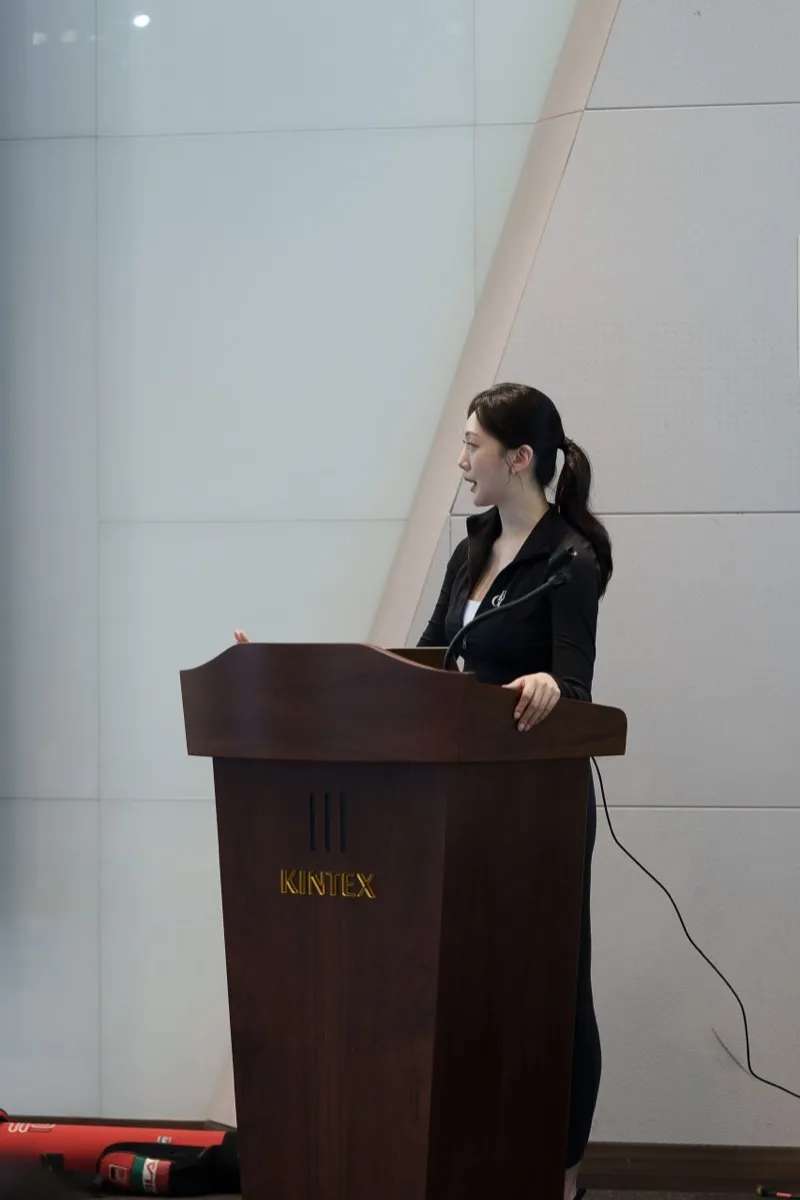
As the National Director for fonv Pilates Association, I participate in and present at domestic and international events including the K-Pilates Convention and IDO Convention, working to promote the excellence of Korean Pilates. The overseas seminars I conducted in Sapporo, Japan and Taipei, Taiwan were part of this effort.
Vision for the Future
Looking back, my journey that began at Chung-Ang University’s dance department has followed one consistent question:
“How do humans move, and how can we move better?”
The answer to this question remains unfinished, and I’ll likely spend a lifetime exploring it. But the conviction I’ve gained from my journey so far is this:
Good movement is the foundation of a good life. And good movement becomes possible when scientific understanding meets warm, thoughtful teaching.
The artistry of contemporary dance, the precision of Pilates, the science of Motor Control — combining these three, I want to continue helping more people with their movement. This journey is also part of a broader story: why Korean Pilates is earning global recognition and how K-Wellness culture is reshaping fitness worldwide.
At mm Pilates, at mm barre n yoga, on international seminar stages, and in instructor training programs — I will keep sharing what I’ve learned along the path I’ve walked.
Curious about my story or want to talk about Pilates? Reach out on Instagram @pilajuliaa. I welcome all conversations about movement.
Transform Your Movement, Transform Your Life
From Golf & Running Pilates to barre n yoga — discover programs designed by a sports science expert.