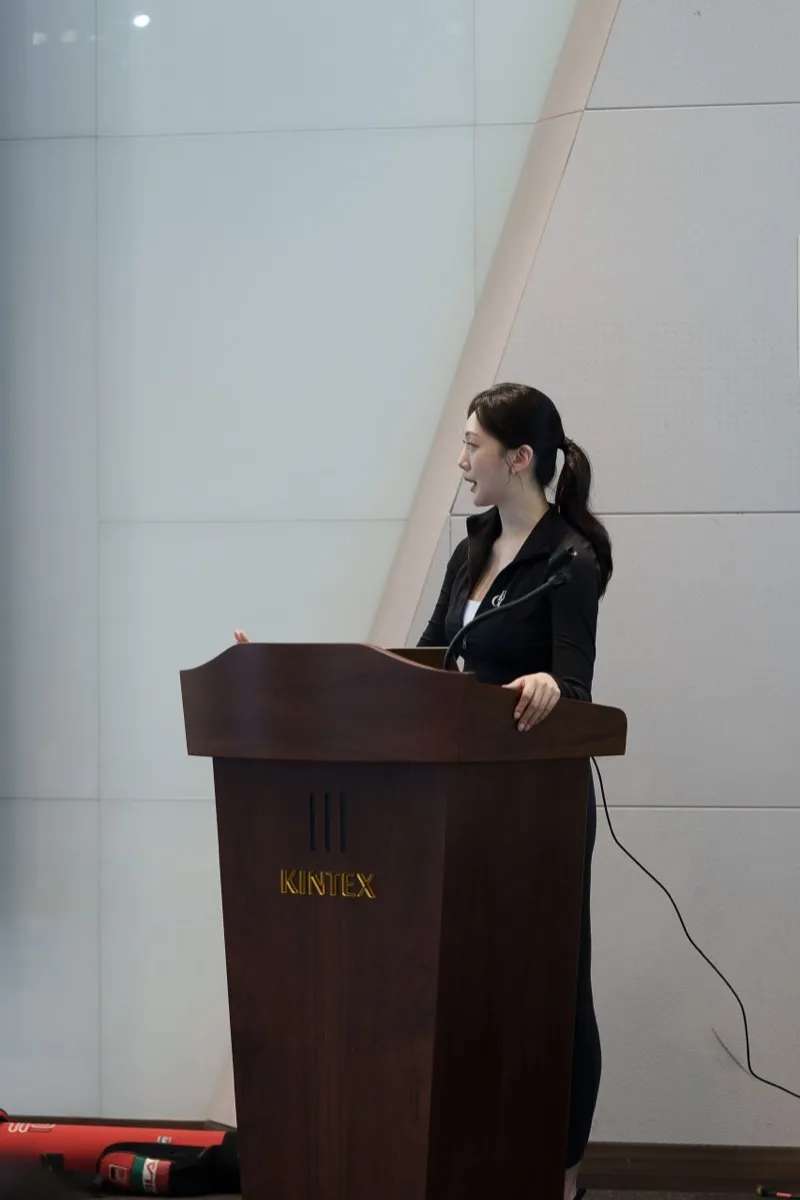
fonv International Seminars: Bringing K-Pilates to Japan and Taiwan
On the plane, reviewing my seminar materials one last time, I thought: What can a Pilates instructor from Korea share with experts in Japan and Taiwan? What is the unique value of Korean Pilates?
The process of finding those answers became the journey of fonv’s international seminars, and what I can say with certainty now is that K-Pilates is already attracting global attention.
What Is fonv Pilates Association and What Does It Do?
fonv is a Korea-based international Pilates education association that combines classical principles with modern exercise science.
fonv Pilates Association is a Korea-based Pilates education association. Its philosophy is to respect the classical principles of Pilates while actively incorporating findings from modern exercise science research.
As fonv’s National Director, I fulfill two roles: managing the overall direction of domestic instructor education programs, and serving as an international seminar instructor to disseminate Korean Pilates methodologies globally.
Why Conduct International Seminars?
Korea’s Pilates market occupies a unique position. The number of Pilates studios per capita is among the highest in the world, and instructor education standards are exceptionally high. Korean Pilates instructors often possess solid knowledge in anatomy, exercise physiology, and rehabilitation medicine.
Yet this excellence hasn’t been sufficiently recognized internationally. Just as K-POP and K-Beauty have earned global recognition, K-Pilates deserves comparable international visibility. fonv’s international seminars are part of the effort to bridge this gap.
What Was Presented at the Sapporo Seminar?
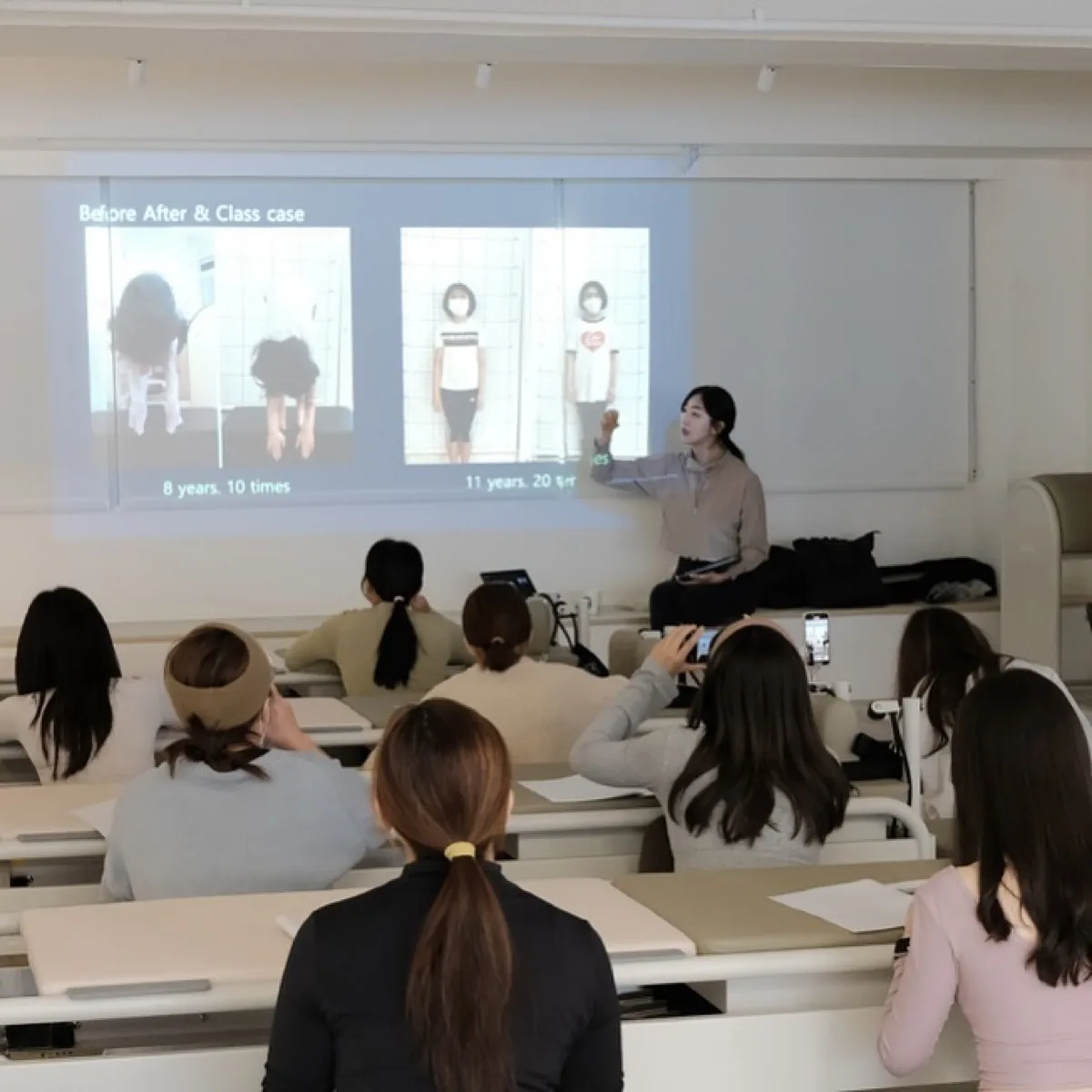
I shared a Pilates-based approach to children’s “movement education,” applying Motor Control theory and objective assessment methods for growing children.
Choosing Sapporo, Japan as our first international seminar location was a meaningful decision. Japan has a high level of understanding of Pilates, and their serious attitude toward education shares similarities with Korea.
Seminar Topic: A Pilates-Based Approach for Growing Children
In Sapporo, I presented on Kids Pilates. Given that posture problems in growing children are an issue across East Asia, the Japanese participants showed strong resonance with the topic.
I conveyed three key points:
First, we must provide children with “movement education,” not just “exercise.” Kids Pilates shouldn’t simply be a watered-down version of adult Pilates programs. We need to design movement tasks appropriate for the child’s developmental stage, allowing physical abilities to develop naturally through play and exploration.
Second, we must understand children’s movement from a Motor Control perspective. I introduced methodologies applying Motor Control theory from my doctoral research to Kids Pilates. Children’s brains learn movement differently from adults, and understanding this difference is the starting point for effective instruction.
Third, objective measurement using assessment tools is essential. We need to move beyond subjective evaluations like “their posture has improved” to track changes through measurable indicators. This increases program credibility and aids communication with parents.
Sapporo vs. Taipei: Two Seminar Experiences
| Sapporo, Japan | Taipei, Taiwan | |
|---|---|---|
| Market maturity | Established, high standards | Early growth, rapidly expanding |
| Topic | Kids Pilates — movement education | Integrative approach — dance + science + Pilates |
| Audience response | Detailed, research-oriented questions | Enthusiastic, practical application focus |
| Key takeaway | Precision drives program improvement | Korean integrative method seen as refreshing |
| Lasting outcome | Deeper research into children’s digital posture | East Asian K-Pilates professional network |
What I Learned in Sapporo
I had thought of the seminar as something I was “giving,” but in reality, I “received” even more. The Japanese instructors’ detailed questions revealed gaps in my presentation, and Japan’s characteristic precision motivated me to develop the program more systematically.
One Japanese instructor’s question—“Has Korea conducted tracking research on the relationship between children’s digital device usage time and posture changes?”—prompted me to investigate related literature more deeply after returning home.
What Was the Response at the Taipei Seminar?
Korean Pilates instructors’ integrative approach drew enthusiastic interest, and a lasting East Asian K-Pilates professional network was formed.
The Taiwan seminar was an entirely different experience. Taiwan’s Pilates market is still in its early growth phase compared to Korea or Japan, but the passion for learning was that much more fervent.
The Reception of the Korean Approach
What particularly interested Taiwanese participants was Korean Pilates instructors’ integrative approach. Korean instructors tend to study broadly across anatomy, exercise physiology, and rehabilitation—not just Pilates—and this seemed refreshing to the Taiwanese participants.
In my case, I specifically demonstrated how my academic background—contemporary dance major → dance master’s degree → sports science doctoral program—integrates into Pilates instruction. The artistry of movement from dance, the connection between dance and Pilates forged in my master’s research, and Motor Control theory from my doctoral program—I conveyed through practical demonstrations how all of this integrates within a single class.
The East Asian K-Pilates Network
The most valuable harvest from the Sapporo and Taipei seminars was the connections with people. A network naturally formed among Pilates professionals from Korea, Japan, and Taiwan to exchange experiences and learn from each other.
This network isn’t a one-time exchange—it’s evolving into ongoing knowledge sharing and collaborative research. Through fonv, we’re planning regular international seminars and preparing online platforms for inter-instructor exchange programs.

What Are the K-Pilates Convention and IDO Convention?
These are Korea’s premier international events where Pilates professionals gather to share the latest research, methodologies, and industry strategies.
Alongside international seminars, I actively participate in domestic international events.
K-Pilates Convention is a venue for examining the present and future of Korean Pilates. Domestic and international experts gather to share the latest research trends, educational methodologies, and business strategies. I have presented workshops on Golf Pilates and Kids Pilates at this event.
IDO Convention is another international event where movement professionals convene, providing valuable opportunities to exchange with experts not only in Pilates but also in dance, yoga, fitness, and other fields.
Every time I participate in these events, I’m struck by the same realization: Korean Pilates professionals are already world-class. What’s needed is better systems to promote and systematically communicate this excellence internationally.
What Is the Present and Future of K-Pilates?
K-Pilates is defined by the harmony between academic depth and practical application — and it has already earned global attention.
K-Pilates isn’t an officially existing term. But just as K-POP established the unique identity of Korean pop music on the world stage, Korean Pilates possesses its own distinctive characteristics.
What are those characteristics? I believe it’s “the harmony between academic depth and practical application.” Korean Pilates instructors don’t simply teach movements—they understand anatomical principles, modify exercises for individual physical conditions, and design programs according to specific objectives. This approach is highly valued internationally.
These seminars are part of a larger story: why K-Pilates is earning global recognition and how Korean wellness culture is reshaping the global fitness landscape. Through WILA, we’re building an even stronger infrastructure for this international exchange.
Going forward, I plan to conduct seminars in more countries through fonv. I want to share the value of K-Pilates in Southeast Asia, Europe, and eventually in the United States — the birthplace of Pilates.
Throughout this journey, I always hold the belief that “sharing is growth.” The person who learns the most from teaching is the instructor themselves.
Interested in fonv seminars, K-Pilates collaboration, or instructor education? Reach out on Instagram @pilajuliaa. Let’s build the future of K-Pilates together.
Transform Your Movement, Transform Your Life
From Golf & Running Pilates to barre n yoga — discover programs designed by a sports science expert.