Pilates During Pregnancy and After: What's Safe, What to Avoid
Few phases of life change the body as quickly and dramatically as pregnancy and the months that follow. Your center of gravity shifts, your hormones loosen every ligament, your core architecture literally splits apart, and your breath pattern fundamentally changes. Very few forms of exercise are equipped to meet a body in this state — but Pilates, done correctly, is one of them.
I have worked with dozens of pregnant and postpartum clients over the past decade, and this guide distills what I wish every woman knew before she walked into her first prenatal class. None of this replaces medical advice — always work with your OB and a qualified instructor — but it will help you ask the right questions.
Is Pilates Safe During Pregnancy?
For a healthy, low-risk pregnancy, Pilates is one of the safest and most recommended forms of exercise available. It builds the deep core and pelvic floor — exactly the muscles that support a growing uterus, reduce back pain, and prepare the body for labor. It has low fall risk, minimal impact, and can be scaled to any energy level.
That said, “Pilates” is a broad category. A standard beginner mat class is not automatically safe during pregnancy — many classical exercises become contraindicated after certain weeks. The right approach is either a dedicated prenatal Pilates class or a private session with an instructor certified in prenatal modifications.
Pregnancy Pilates by Trimester: What Changes and When
Each trimester has its own rules. Here is the framework I use with every prenatal client.
First Trimester (Weeks 1–13)
This is often the hardest trimester psychologically — you are tired, possibly nauseated, and not visibly pregnant yet. Most classical Pilates exercises are still safe, but listen to your energy.
- Keep: Footwork, breath work, gentle spinal articulation, side-lying leg work
- Stop: Full roll-ups and deep crunches (to protect the linea alba preemptively)
- Modify: Reduce spring resistance; shorter sessions (30–40 min instead of 55)
- Watch for: Light-headedness, unusual cramping — stop and consult your OB
Second Trimester (Weeks 14–27)
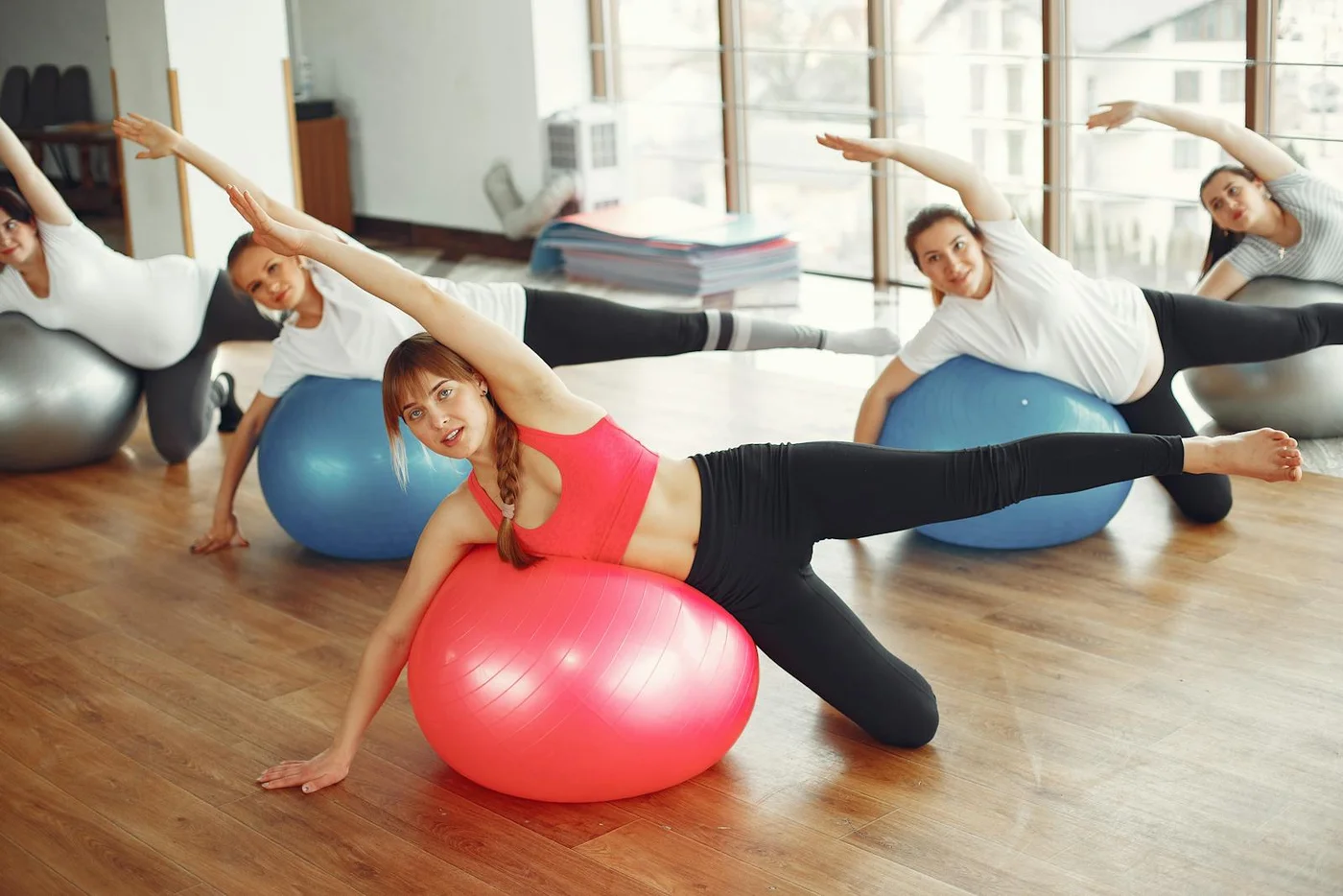
Energy typically returns in this phase, and many women feel their strongest. But positional rules tighten significantly.
- Stop prone positions (lying face-down) from week 16
- Stop supine positions (lying flat on back) longer than 3–5 minutes from week 20 — use a wedge or incline
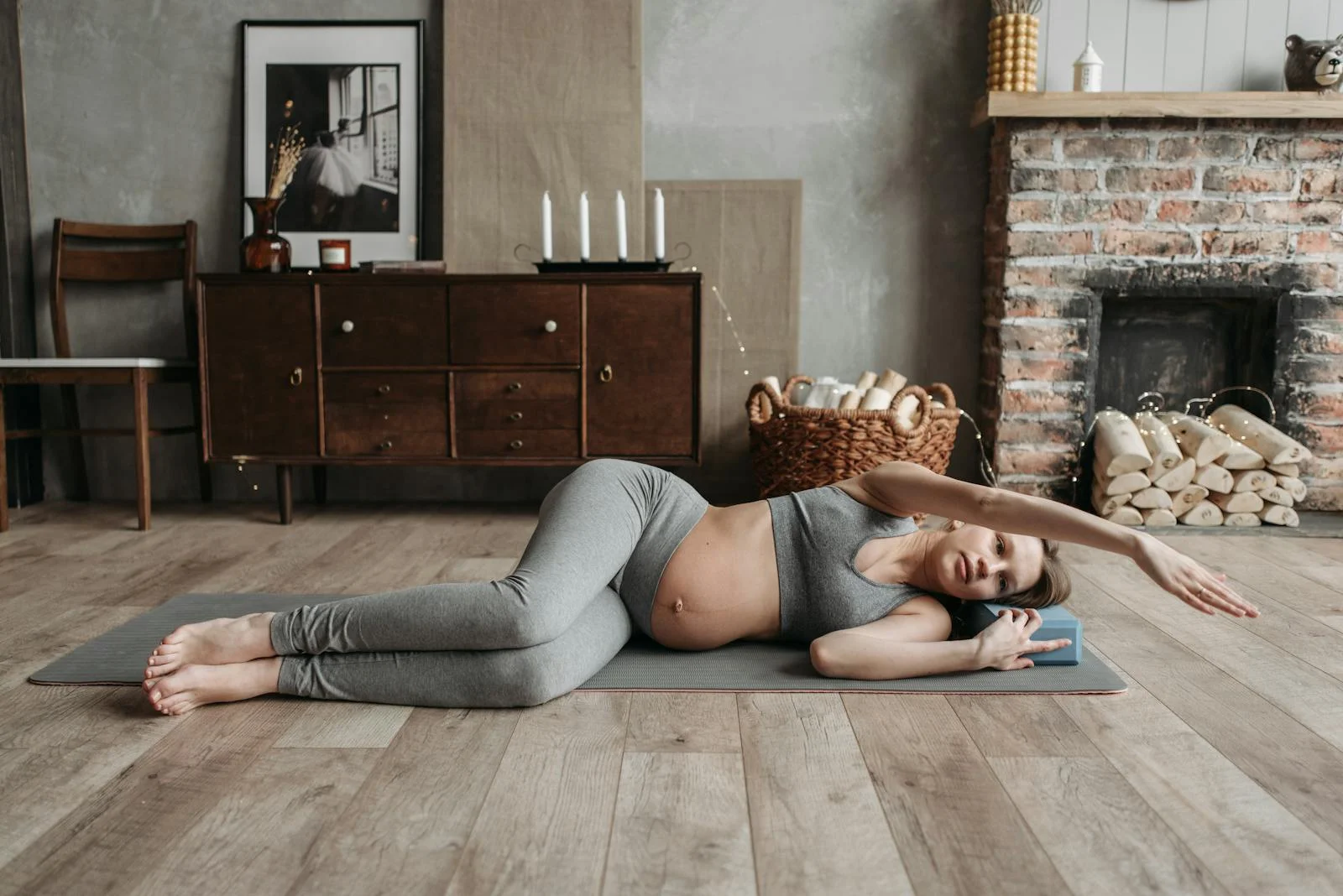
- Emphasize: Pelvic floor coordination, hip opening, thoracic mobility, side-lying strength work
- Avoid: Deep twists, full inversions, heavy abdominal flexion
This is also when I introduce breathing patterns for labor — learning to release the pelvic floor on exhale, not just contract it. Most women have been taught only to squeeze, which can actually make labor harder.
Third Trimester (Weeks 28–40)
The goal in the third trimester shifts from “training” to “maintenance and preparation.” The body is under maximum load, and we focus on comfort, circulation, and labor readiness.
- Core focus: Transversus abdominis only — no rectus abdominis (six-pack muscle) loading
- Spring settings: Very light; the reformer is used more for support than resistance
- Positions: Side-lying, seated, standing, quadruped (hands and knees)
- Pelvic floor: Alternate between gentle contractions and intentional releases
What Pilates Exercises to Avoid During Pregnancy
Regardless of trimester, some classical exercises should come out of the program entirely once you confirm pregnancy:
- Traditional crunches, Hundred with head lifted, full roll-ups — any exercise that pushes the abdominal wall outward, worsening diastasis recti
- Teaser, jackknife, and other extreme flexion/extension — excessive intra-abdominal pressure
- Deep backbends and inversions — blood pressure fluctuations, risk of falls
- Prone (face-down) work after ~16 weeks — direct pressure on the belly
- Heavy spring loading on abdominals — the linea alba is already under tension
Every one of these exercises has a safe prenatal alternative. An instructor trained in prenatal modifications will know the substitutions without needing to think. If your regular instructor hesitates, find someone who specializes.
Postpartum Pilates: How to Return Safely
The postpartum period is where most women make their biggest mistakes — usually by returning too fast and going too hard. Your body just completed a physiological event on par with a major surgery. It needs staged recovery.
Weeks 0–2: Rest and Breath
Almost no movement beyond walking, gentle stretching, and diaphragmatic breathing. The breath work is the real foundation — restoring the pressure system between the diaphragm and pelvic floor that birth disrupted. Five minutes of conscious breathing, lying on your side, is more valuable than any “quick postpartum workout” on social media.
Weeks 2–6: Pelvic Floor Reconnection
With your OB’s approval, start gentle pelvic floor engagement — both contractions and, critically, releases. Many women have pelvic floor tension (not weakness) after delivery, and pure Kegel exercises can make this worse. A qualified instructor will assess which direction your pelvic floor needs to go.
Weeks 6–12: Deep Core Rebuilding
After your postpartum checkup and clearance, you can begin guided Pilates programming. This is when I assess diastasis recti — the separation between your rectus abdominis muscles. A gap of more than 2 finger-widths means we avoid traditional core work and focus on transversus abdominis exclusively until it closes.
C-section clients need an additional layer of care: scar mobilization, nerve sensitization work, and much slower loading. Expect 8 to 12 weeks before any abdominal work, and even then, we build very gradually.
Month 4 and Beyond
Most clients are ready for progressively more challenging Pilates programming from month 4, assuming diastasis has closed and pelvic floor is coordinated. This is also when I often introduce mat Pilates work for home practice — short maintenance routines that fit around a newborn’s schedule.
The Diastasis Recti Question
Almost every pregnant person develops some diastasis recti (DR) — the separation of the abdominal wall at the linea alba. It is a normal adaptation. The question is not whether you will have it, but how your body heals afterward.
Key points most women are never told:
- DR does not automatically heal on its own for everyone. Without guided rehab, 30-40% of women still have a significant gap at 12 months postpartum.
- Traditional crunches can make DR worse, not better.
- The goal is not to “close the gap” at any cost, but to restore tension in the linea alba connective tissue so the core can transmit force again.
- A skilled instructor or women’s health physiotherapist can teach you to self-assess.
Common Myths About Prenatal and Postpartum Pilates
After a decade of teaching, these are the misconceptions I clear up most often:
- “I can do my normal Pilates class if I tell the instructor.” Only if the instructor has prenatal training. Otherwise, modifications will be guesswork.
- “Once I’m cleared at 6 weeks, I can go back to pre-pregnancy intensity.” Clearance means safe to move, not safe to train at full capacity. Give yourself 6 months minimum.
- “My belly will look the same as before if I work hard enough.” Some structural changes are permanent, and that is normal. The goal is function and strength, not a pre-pregnancy mirror image.
- “Breastfeeding means I shouldn’t do core work.” Not true — but relaxin hormone stays elevated while breastfeeding, so ligaments remain looser. Progress loading more gradually.
Finding the Right Instructor
Not every Pilates instructor is trained for pregnancy and postpartum, and honestly, many should not teach this population. Look for:
- Specific prenatal/postnatal certification, not just general Pilates credentials
- Experience — ask how many pregnant and postpartum clients they have worked with
- A clear assessment process, including diastasis recti screening
- Communication with your medical team — a good instructor will ask for OB clearance, not just accept your word
At mm Pilates, our prenatal and postpartum programming is built around small-group or private sessions so that we can assess and adjust individually. The reformer is particularly valuable here because the spring support can reduce load when needed — something a mat class cannot do.
The Bigger Picture
Pregnancy and postpartum are not obstacles to fitness — they are teachers. Very few life experiences will force you to understand your deep core, breath, and pelvic floor with the precision this season demands. Clients who rebuild correctly often end up stronger and more aware than they were before pregnancy, because they finally learned what their body actually needs.
That learning takes patience. It takes the right guide. And it takes a willingness to move slowly when social media is telling you to “bounce back.” There is no bouncing. There is only a careful, honored return.
Thinking about prenatal or postpartum Pilates? Explore Julia’s programs or reach out on Instagram to discuss your stage and goals.
Transform Your Movement, Transform Your Life
From Golf & Running Pilates to barre n yoga — discover programs designed by a sports science expert.